






Automotive Industry


Project Overview
Located in Hefei, Anhui Province, this project serves a group-level enterprise that ranks among China's leading automotive component manufacturers. The Anhui facility occupies a total area of 34,000 square meters.The planned production workshop and warehouse measure 156.48 meters in length and 180.8 meters in width, supporting three core processes: injection moulding, painting, and assembly. The facility primarily manufactures automotive exterior components. Logistics between these three production processes are managed through an automated material handling system, enabling automated inter-process transfer and semi-finished product storage. This enhances space utilization, improves operational efficiency, and reduces personnel involvement across all stages.

Highlights Showcase
-
Fully automated inbound/outbound management;
-
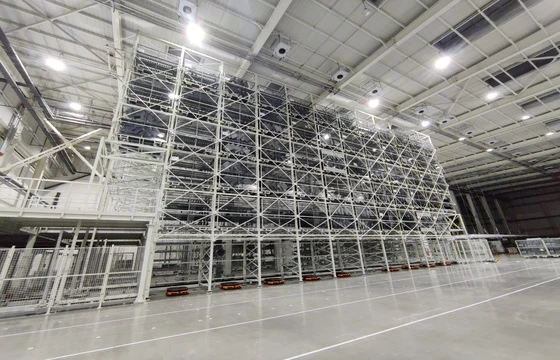
Phase I comprises 660 storage bays, with provision for an additional 388 bays in later phases, enabling flexible project expansion;
-
Multi-cycle operation of stacker cranes in automated storage systems: 58 pallets × 5 cycles = 290 pallets/hour
-
Logistics system efficiency: 82 pallets/hour
-
Industry-leading model: goods-to-person distribution

Solutions
The customer seeks a cost-effective solution utilizing advanced logistics planning and system integration technology to optimize logistics routes, enhance digital and automation levels, establish an intelligent fully automated logistics system, manage and coordinate equipment operations, and reduce costs while improving efficiency. The entire project must integrate assembly and painting process areas with logistics conveyance systems to achieve fully automated inbound/outbound operations. It must align with production rhythms across all processes, plan optimal and most efficient storage and logistics conveyance routes, and incorporate future scalability throughout the design.
Based on client requirements, we shall develop an automated multi-level warehouse and automated logistics distribution system supporting the three core production processes of injection moulding, painting, and assembly for automotive exterior components. This aims to enhance operational efficiency between processes and maximize warehouse space utilization. Specific solutions include:
1.Implementation of high-bay shelving systems and aisle-type stacker crane systems to achieve intelligent automated in-plant warehousing.
2.Designing a goods-to-person replenishment scheme for the assembly area, incorporating shelving buffer zones and workstation holding areas + AGV delivery solutions to genuinely achieve cost reduction and efficiency gains.
3.Integrating factory functions—painting, automated storage, and assembly—through logistics equipment such as conveyor systems and AGVs to establish seamless automated in-factory logistics.
4. Establishing PLC electrical control systems, WMS warehouse management systems, WCS equipment control/scheduling systems, and information identification systems, linking to the client's host computer systems to realize a digital factory.
5.Integrate logistics and information flows across the entire factory, eliminating isolated production model.
6.Establish an industrial intelligent production model integrating automation and informatization.
Based on client requirements, we shall develop an automated multi-level warehouse and automated logistics distribution system supporting the three core production processes of injection moulding, painting, and assembly for automotive exterior components. This aims to enhance operational efficiency between processes and maximize warehouse space utilization. Specific solutions include:
1.Implementation of high-bay shelving systems and aisle-type stacker crane systems to achieve intelligent automated in-plant warehousing.
2.Designing a goods-to-person replenishment scheme for the assembly area, incorporating shelving buffer zones and workstation holding areas + AGV delivery solutions to genuinely achieve cost reduction and efficiency gains.
3.Integrating factory functions—painting, automated storage, and assembly—through logistics equipment such as conveyor systems and AGVs to establish seamless automated in-factory logistics.
4. Establishing PLC electrical control systems, WMS warehouse management systems, WCS equipment control/scheduling systems, and information identification systems, linking to the client's host computer systems to realize a digital factory.
5.Integrate logistics and information flows across the entire factory, eliminating isolated production model.
6.Establish an industrial intelligent production model integrating automation and informatization.